Guides
What Your Texting Says About Your Attachment Style
Attachment styles show up in texting as concrete, countable behaviors: double texts fired into silence, one-word replies that create distance, hot-and-cold cycles, or a steady rhythm that never makes headlines. Reading those patterns in a real conversation tells you more than any label, and none of it is a diagnosis.
Attachment theory describes how people tend to handle closeness and distance: patterns that formed early and now run quietly in the background of every relationship. A chat thread happens to be the perfect place to watch them work: every bid for attention, every retreat, every repair attempt is right there with a timestamp. Let's be precise, though: what texting reveals is patterns of behavior in one relationship, not a clinical profile of a person. Keep that frame and this gets genuinely useful.
Attachment styles in texting
Four broad patterns, translated into what they actually look like on a phone.
Secure: the boring, steady rhythm
- Reply pace stays roughly consistent whether things are great or tense.
- Silence isn't an emergency: a slow day gets a shrug, not a spiral.
- Needs get stated directly: "I'd love to see you this week" instead of a trail of hints.
- After friction, there's repair: a straightforward "hey, that came out wrong" rather than three days of frost.
Secure texting is unglamorous by design. It doesn't produce screenshots worth sending to the group chat, which is rather the point.
Anxious: double texts and protest signals
- Double-texting under silence: then a third, then a "sorry for the spam haha", then a fourth. The messages aren't conversation; they're checks on the connection.
- Read receipts get forensic analysis. Reply-time gaps get counted, compared, and mourned.
- Protest signals: sudden coldness, a pointed one-word reply, or a dramatic "fine." designed to provoke reassurance rather than express an actual state.
- Apology spirals: over-apologizing for normal messages, walking back reasonable asks.
Avoidant: the deactivating one-word reply
- One-word replies as distance regulation: "yeah", "cool", "maybe", deployed precisely when the conversation gets warm or asks for something.
- Fine in person, distant in text; the keyboard is where closeness gets rationed.
- Disappears after the best moments: a great date, a vulnerable exchange, then resurfaces as if nothing happened.
- "Sorry, been busy" as a standing policy rather than an event.
Note the overlap with plain dry texting: the difference is timing. A style is dry all the time; deactivation switches on exactly when intimacy rises.
Disorganized: hot-cold cycling
- Intense engagement: long messages, fast replies, big feelings, followed by abrupt withdrawal, on a loop.
- Push-pull in the same thread: a bid for closeness ("miss you") followed by a retreat ("anyway, busy week") within minutes.
- The pattern reads as mixed signals from outside because it is mixed: wanting closeness and fearing it, both at full volume.
Patterns, not a diagnosis
Now the caution, stated plainly, because this is where attachment content usually goes off the rails:
- Context mimics style. A brutal month at work produces avoidant-looking texting. A brand-new relationship produces anxious-looking texting in almost everyone. One chat is one context.
- You're in the data too. Their double texts and your slow fades are one system; the same person texts "securely" with one partner and anxiously with another.
- Labels are lenses, not verdicts. "This conversation shows anxious-avoidant friction" is useful. "He is an avoidant," pronounced from six screenshots, is astrology with citations.
Undertone's own footer says it best: it offers perspective on conversations. It isn't therapy, diagnosis, or relationship advice. If attachment wounds are genuinely running your life, that's a conversation for a professional, not an app or a listicle.
What to actually do with this
- Name your own pattern first. It's the only one you can change, and spotting your protest signals or deactivations in writing is half the battle.
- Watch trends, not incidents. One hot-cold week is a mood. The same cycle repeating across months is a pattern worth naming.
- Make one clear ask. Whatever the styles involved, "I like consistent contact. Is that something you want too?" beats ten hints and a protest signal.
How Undertone reads this for you
Spotting your own patterns in a chat you're emotionally inside of is genuinely hard: that's what Undertone is for. Import a WhatsApp chat export, or paste the conversation from Instagram, Snapchat, Tinder, Bumble, Hinge, iMessage, or Messenger. A three-question quiz sets the context: who you are, who they are, what this is. Before analysis, an explicit consent screen: your chat goes to an AI provider (currently OpenAI, reached via OpenRouter) for a single analysis, our own service never stores it, and it's never used to train AI models.
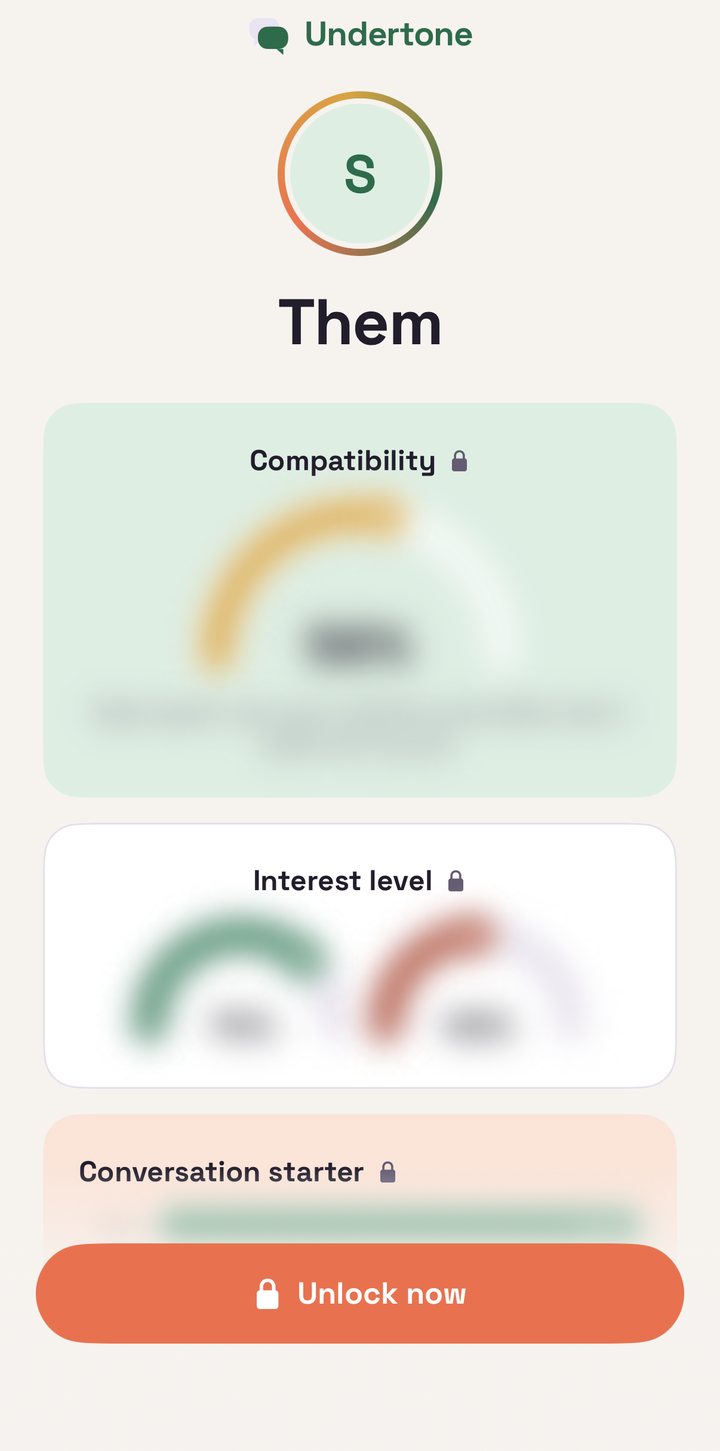
The core read is free to see take shape: compatibility percentage, interest level on both sides, red and green flags decoded, relationship dynamics. The attachment-style and relationship-pattern read is part of Undertone Premium: it looks at reply rhythms, double-text clusters, deactivation timing, and repair attempts across the whole history, and names the pattern in plain English, always as a pattern in this conversation, never as a verdict on a person. Premium also unlocks suggested conversation starters matched to the dynamic.
FAQ
What attachment style does my texting show?
Texting can show attachment-style patterns: double-texting under silence and protest signals lean anxious; deactivating one-word replies and disappearing when things get close lean avoidant; hot-cold cycling leans disorganized; a steady, boring rhythm leans secure. These are patterns in behavior, not a diagnosis of a person.
Can texting diagnose my attachment style?
No. Texting behavior is context-dependent: a brutal work month can mimic avoidance, and a brand-new relationship can mimic anxiety. Reading attachment patterns in a chat offers perspective on the dynamic; it isn't therapy, diagnosis, or a verdict on who someone is.
Is Undertone's attachment-style read free?
The attachment-style and relationship-pattern read is part of Undertone Premium, $29.99/year or $4.99/week, with the price visible before you commit and a clear cancel path.
Stop rereading the chat.
Undertone launches soon on the App Store: $29.99/year or $4.99/week, no free trial.
Get early access